University of Illinois Chicago Argonne National Laboratory
OmniRAS
A JEPA catalog in robot-assisted surgery

OmniRAS

Standardizing foundation model training and evaluation in robot-assisted surgery.

Hover any region of the card to read it below · click to pin, Esc to release
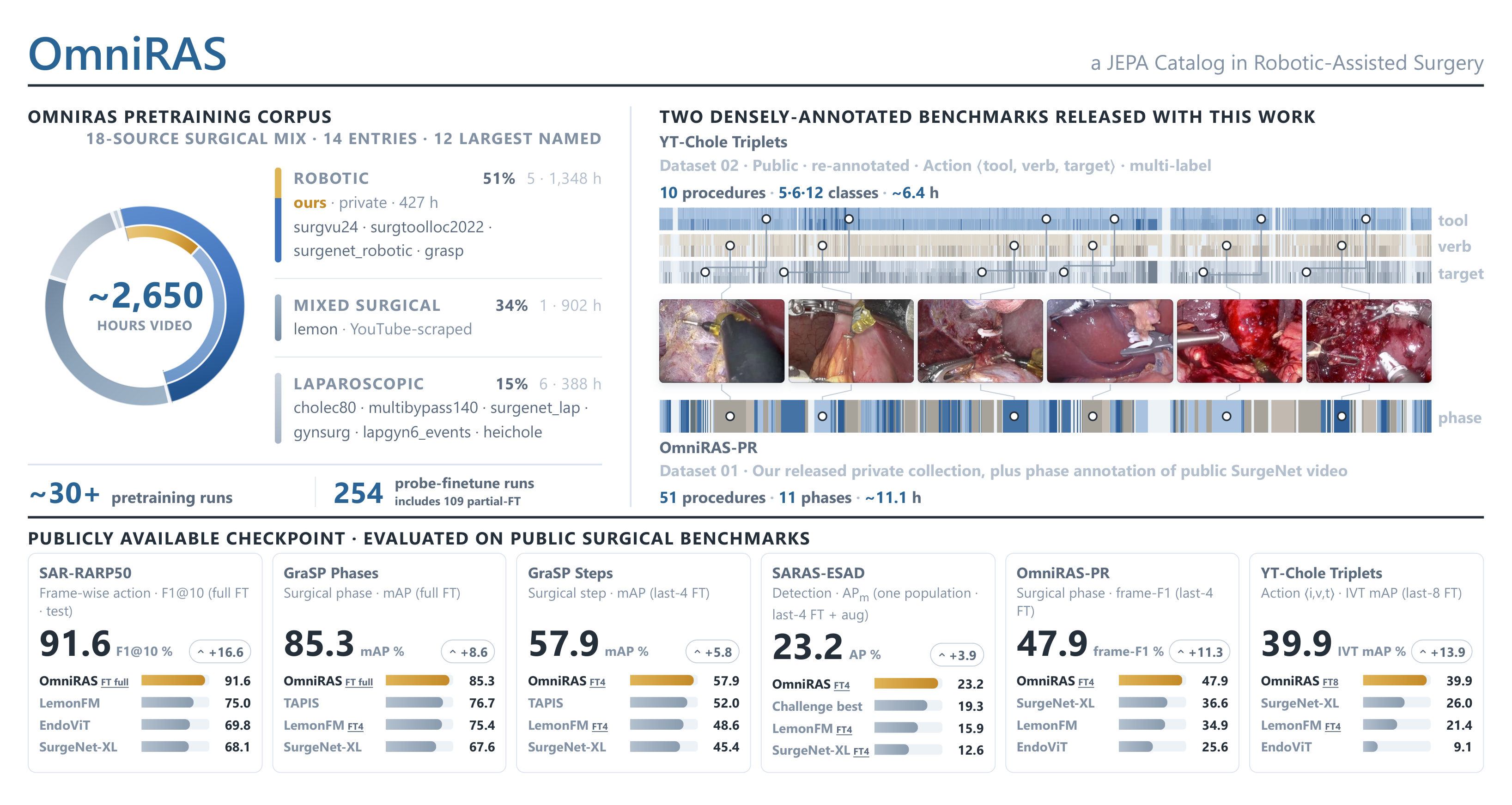
OmniRAS overview. Left: the pretraining corpus, about 2,650 hours across 19 sources — 51% robotic, 34% mixed surgical, 15% laparoscopic. Right: the two densely annotated benchmarks released with this work, YT-Chole Triplets and OmniRAS-PR. Bottom: headline results on six surgical benchmarks, with OmniRAS leading each panel.

Overview. Billion-scale V-JEPA-2.1 encoders are continued-pretrained at up to 256 nodes on a 19-source, approximately 2,650-hour surgical-video catalog that is 51% da Vinci robotic video by hours, and evaluated on the two densely annotated robotic-cholecystectomy datasets released with this work together with the public SAR-RARP50, GraSP, and SARAS-ESAD benchmarks. Model card based on arXiv v2, with the run count corrected on September 18, 2026: 254 downstream seed-level runs, including 109 with partial backbone fine-tuning. Updated model card (PDF) · Archived arXiv figure.
01

Abstract

Few foundation models exist for robot-assisted surgery, partly because large robotic-surgery video corpora are difficult to assemble and existing models are evaluated mostly on laparoscopic benchmarks. We present OmniRAS, a family of 1B- and 2B-parameter V-JEPA-2.1 encoders for robot-assisted surgery, and detail their training.

First, we release two densely annotated robotic-cholecystectomy datasets: OmniRAS-PR and a multi-label YT-Chole tool–verb–target task, the first triplet-style annotation for robotic cholecystectomy, together with splits, probe protocols, and an inter-rater study validating the shared phase ontology. Second, we document continued pretraining at up to 256 compute nodes with global batch 6,144 over 19 sources totaling approximately 2,650 hours of surgical video, 51% robotic, and analyze compute and data composition. Third, we evaluate against raw V-JEPA-2.1 and specialized surgical models on six tasks spanning triplet, phase, and step recognition, action segmentation, and detection, under frozen-encoder and final-four-block fine-tuning regimes.

Across three seeds, this yields 254 downstream runs, including 109 with partial backbone fine-tuning. The best OmniRAS models achieve the strongest adapted results across all task families, while frozen differences are smaller.

02

The campaign in numbers

2,650h
Surgical video in the pretraining catalog
51%
da Vinci robotic video, by hours
19
Distinct sources in the mix
256
Compute nodes at peak
6,144
Global batch size
3,038
Node-hours across three production runs
254
Downstream seed-level runs
109
Of those, unfreezing part of the backbone
03

Two benchmarks released with this work

Public surgical corpora cover a narrow band of procedures, and for cholecystectomy in particular offer no multi-label interaction annotation on robotic video. These two datasets span complementary temporal scales: phase labels capture procedural state under a shared coarse ontology, while triplets capture short interactions at a finer granularity.

OmniRAS-PR

Phase recognition · robotic cholecystectomy

51 procedures under a unified 11-class procedural-phase ontology, combining 41 private procedures with ten publicly available SurgeNet procedures. The public portion holds out two complete procedures for evaluation, preventing clip-level leakage.

Procedures
51 (41 private + 10 public)
Annotated video
~11.1 h
Classes
11 phases
Private split
156,217 train / 41,108 val
Public split
2,704 train / 679 val
Primary metric
macro-F₁

YT-Chole Triplets

Action ⟨tool, verb, target⟩ · multi-label

A re-annotation of ten SurgeNet batches as a multi-label triplet prediction problem with three independent axes. Each axis carries an independent sigmoid head, since several labels can be active in one clip. To our knowledge, the first triplet-style action annotation defined on robotic cholecystectomy video.

Procedures
10 batches, ~3 procedures each
Annotated video
~6.4 h
Classes
5 tools · 6 verbs · 12 targets
Splits
3,537 train / 1,696 val
Primary metric
IVT mAP
clippergrasperhook irrigatorscissors
Ontology validation
κ = 0.807 at ±4 s

A 10% sample of YT-Chole was independently re-annotated for phase by two raters against the existing reference. Mean pairwise Cohen's κ over all eleven classes is 0.664 at zero boundary tolerance — substantial on the Landis–Koch scale, and reached independently by every one of the three pairs — rising to 0.741 at ±2 s and 0.807 at ±4 s. The residual disagreement is structural rather than interpretive: 82.1% of it involves the five-phase Calot's-triangle cluster, whose sub-activities are performed concurrently rather than in sequence. Pooling that cluster raises the mean to 0.833, and the coarser seven-class view is released alongside the full ontology.

The triplet ontology was assessed separately along its three axes. At ±1 s tolerance, Krippendorff's α reaches 0.917 for instrument, 0.666 for verb, 0.693 for target, and 0.722 for the complete triplet.

04

Results across six task families

Every encoder is evaluated under the same probe protocol: matched task definitions, matched training protocols, and a task head whose design is fixed across backbones, so that a difference in score reflects the representation rather than the readout. Each panel below reports the paper's representative configuration for that benchmark against the strongest published or baseline system on the same task.

OmniRAS (ours) Baselines & published systems ± 1 s.d. over three seeds All panels 0–100 · mean ± std labelled on every bar

SAR-RARP50

Action segmentation · F₁@10 · full FT
+16.6
OmniRAS FT full91.56 ± 0.25
LemonFM74.99 ± 0.68
EndoViT69.78 ± 0.36
SurgeNet-XL68.11 ± 0.91

GraSP Phases

Phase recognition · mAP · full FT
+8.6
OmniRAS FT full85.34 ± 0.33
TAPIS76.72
LemonFM FT475.37 ± 0.31
SurgeNet-XL67.58 ± 1.47

GraSP Steps

Step recognition · mAP · FT4
+5.8
OmniRAS FT457.85 ± 1.29
TAPIS52.01
LemonFM FT448.56 ± 1.27
SurgeNet-XL45.35 ± 0.67

SARAS-ESAD

Detection · APm × 100 · FT4 + aug
+3.9
OmniRAS FT423.19 ± 1.99
Challenge best19.28
LemonFM FT415.85 ± 0.39
SurgeNet-XL FT412.56 ± 0.32

OmniRAS-PR

Phase recognition · frame-F₁ · FT4
+11.3
OmniRAS FT447.92 ± 0.53
SurgeNet-XL36.59 ± 2.71
LemonFM34.94 ± 1.43
EndoViT25.63 ± 4.33

YT-Chole Triplets

Triplet ⟨i,v,t⟩ · IVT mAP · FT8
+13.9
OmniRAS FT839.92 ± 0.91
SurgeNet-XL26.03 ± 0.16
LemonFM FT421.35 ± 0.06
EndoViT9.14 ± 0.14

Bars without a whisker are single published numbers with no seed spread reported by their authors: the SAR-RARP50 reference (84.10, not shown above), TAPIS, and the best SARAS-ESAD challenge submission.

The complete figures from the paper

The panels above compress each benchmark to one representative metric. Below is every result figure in full — each encoder configuration, each metric, and the three-seed standard deviation — replotted from the paper's own values so a metric can be selected and the field narrowed to the comparison at hand. Gold marks the best bar in a panel, solid blue a fine-tuned configuration, grey a frozen probe or external baseline. Each figure links to the original PDF from arXiv v2 (September 9, 2026).

One difference from the printed plates: every axis here starts at zero, so bar length stays proportional to the value. Several paper panels crop the axis to spread a tight field out, which reads well on the page but makes a bar twice as long as another that is a few points behind it. Every mean and standard deviation is the paper's own.

SAR-RARP50

Fig. 6 · two metrics · 15 configurations Paper figure (PDF)
SAR-RARP50 action recognition, official test split. Every billion-scale video encoder already clears the published 84.10 reference under frozen probing; full fine-tuning of the 36.86 M-sample OmniRAS 2B checkpoint gives the strongest result in both panels. Error bars are the three-seed standard deviation; the published reference reports none.

GraSP

Fig. 10 · four metrics · 14 configurations Paper figure (PDF)
GraSP phase and step recognition. The two optima fall under different adaptation regimes: full fine-tuning leads phase recognition, while last-four-block fine-tuning leads step recognition and full fine-tuning drops to 38.91 step mAP. TAPIS is a single published number and carries no error bar.

OmniRAS-PR

Fig. 8 · six metrics · 13 configurations Paper figure (PDF)
OmniRAS-PR phase recognition and temporal segmentation. Frame-F₁ and phase mAP measure per-frame discrimination; F₁@10/25/50 and the edit score additionally penalise fragmented predictions. OmniRAS 2B FT4 leads frame-F₁ and the segmental metrics; the frozen SITL-only configuration has the highest phase mAP. Error bars are the three-seed standard deviation.

YT-Chole Triplets

Fig. 7 · five metrics · 13 configurations Paper figure (PDF)
YT-Chole action-triplet recognition. Joint ⟨tool, verb, target⟩ mAP alongside the three component axes. Depth of adaptation matters more here than anywhere else in the suite: extending fine-tuning from the last four to the last eight blocks lifts joint IVT mAP from 37.68 to 39.92. Target recognition carries the remaining headroom.

SARAS-ESAD

Fig. 9 · six metrics · 20 configurations Paper figure (PDF)
SARAS-ESAD action detection, common-population rescoring. Last-four-block adaptation with augmentation leads APmean, AP10 and AP50, above the best challenge submission on each. Augmentation is applied to our models only. The challenge submission is a single published number with no seed spread.

Adaptation matters more than substitution. OmniRAS benefits are most consistent once part of the backbone is allowed to adapt. Frozen comparisons are mixed, but partial fine-tuning improves over the corresponding raw initialization on both YT-Chole triplet scales, reverses the frozen ordering on GraSP, and produces the strongest OmniRAS-PR phase and SARAS-ESAD models. The two GraSP optima also occur under different adaptation regimes: full fine-tuning is best for phase recognition (85.34 ± 0.33 mAP), whereas last-four-block fine-tuning is best for step recognition (57.85 ± 1.29 mAP). The strongest transfer does not come from applying one downstream recipe everywhere.

05

Continued pretraining at production scale

Continued pretraining resumes the released V-JEPA-2.1 objective on the surgical catalog at 384² resolution and 16 frames. Production runs use 256 compute nodes with a global batch of 6,144 and a fixed 50 iterations per epoch, so epoch counts are directly comparable across arms of the same run.

Three production runs. Probes are read-only diagnostics: their labels and metrics never enter the pretraining update rule.
Production run Epochs Node-hours YT-Chole IVT mAP GraSP phase macro-F₁
9.22 M samples3043833.373.5
18.43 M samples6087232.475.0
36.86 M samples2001,72835.784.0

The longest production run yields the strongest transfer, but its catalog also changed, so the gain cannot be attributed to compute alone. The one matched-budget comparison — 9.22 M to 18.43 M samples under the same catalog and recipe — was approximately probe-neutral. We report the campaign as practical guidance rather than a scaling law.

Three production runs, 3,038 node-hours

Fig. 5 · prediction-term training loss, per-epoch mean Paper figure (PDF)
Move along the plot to read every epoch · rings are probed checkpointsScroll the plot sideways · tap it to read an epoch
3,038 node-hours of surgical continued pretraining. Each trace is the prediction-term training loss of one production run against cumulative node-hours at 256 nodes. Rings mark the checkpoints probed read-only on YT-Chole IVT mAP and GraSP phase validation macro-F₁; those labels never enter the pretraining update rule. Across successively larger budgets optimization keeps improving, but the probes do not follow it uniformly: the two smaller runs saturate and wander, while the 36.86 M-sample run reaches both the lowest loss and its best probes, 35.7 IVT and 84.0 GraSP, at its final checkpoint. Traces are the paper's own per-epoch values.
Probed checkpoints as a table
RunEpochNode-hours Training lossYT-Chole IVT mAPGraSP phase macro-F₁
L1

Use complementary probes throughout production training

Select probes with different temporal and semantic requirements in advance and evaluate them at fixed checkpoints. YT-Chole IVT captures short-horizon, spatially grounded activity; GraSP phase recognition probes longer-horizon procedural context. Their joint trajectory reveals both checkpoint sensitivity and whether continued self-supervised optimization is actually producing increasingly transferable representations.

L2

Allocate budget to long runs before allocating it to variants

Clear transfer gains emerged only beyond inexpensive screening budgets. A null result at small scale should not be read as strong evidence that an intervention is ineffective. Once the recipe and evaluation harness are validated, extend a strong configuration to production scale before distributing the same compute across many shallow variants.

L3

Lock reproducibility conventions and diagnostic probes before launch

Checkpoint indexing, epoch definitions, data manifests, and probe locations must be fixed as part of the training specification — ambiguities are difficult to reconstruct after long distributed runs. The evaluation suite should also include at least one diagnostic outside the target surgical benchmarks.

Specialization has a cost

Surgical continued pretraining is specialization, not free improvement. With Kinetics-400 rehearsal during pretraining, OmniRAS reaches 53.82 top-1 and 44.70 macro-F₁ on Something-Something-v2, against 60.27 and 52.58 for the raw Meta 2B initialization — 6.45 and 7.88 points of general-action capability traded for surgical transfer. That trade-off is invisible from the surgical benchmark suite alone, which is why the campaign carries a general-video probe.

06

A label-free test of the backbone

Every downstream number depends to some extent on the task-specific readout. We therefore replicate the V-JEPA-2.1 masking objective as an evaluation — no task head anywhere in the loop — and ask whether the surgical checkpoint predicts masked targets in its own latent space more accurately than the checkpoint it was initialized from.

60 / 60 paired comparisons favour the surgical checkpoint

Across five corpora — OmniRAS-PR, GraSP under both the phase and step sampling protocols, SAR-RARP50, and SARAS-ESAD — the surgically pretrained checkpoint achieves higher matched cosine similarity, higher cosine lift, and lower L₁ prediction error in every evaluation setting. At the independent source-unit level the direction favours it in all 60 of 60 paired comparisons. The frozen probes therefore do not indicate that surgical CPT left the representation unchanged; the label-free result identifies the readout as the cause of the frozen-probe ties.

07

Data and model release

To support reproducibility and further research, we will release all OmniRAS checkpoints together with the two datasets introduced in this work. The two datasets were constructed under two separate IRB-approved protocols, and their release will follow the corresponding institutional, privacy, and data-use requirements.

arXiv preprint arXiv:2608.31048 [eess.IV], 31 August 2026; full text, 18 pages including diagnostic appendices
Available
Journal version Submitted to IEEE Transactions on Robotics
Under review
OmniRAS checkpoints 1B and 2B V-JEPA-2.1 surgical encoders
Access by request
OmniRAS-PR 51 procedures, 11-class phase ontology, splits and probe protocol
Access by request
YT-Chole Triplets Multi-label tool–verb–target annotations, splits and probe protocol
Access by request
Evaluation code Probe heads, training configs, aggregation scripts
Pending
08

Cite this work

@article{borgioli2026omniras,
  title   = {OmniRAS: Standardizing Foundation Model Training and
             Evaluation in Robot-Assisted Surgery},
  author  = {Borgioli, Leonardo and Getty, Neil and Xiu, Wenli and
             Cassiani, Jessica and Ducas, Alvaro and Orda, Carlos Agustin and
             Waris, Hira and Xia, Fangfang and Stevens, Rick and
             Giulianotti, Pier Cristoforo and {\v{Z}}efran, Milo{\v{s}}},
  journal = {arXiv preprint arXiv:2608.31048},
  eprint  = {2608.31048},
  archivePrefix = {arXiv},
  primaryClass  = {eess.IV},
  note    = {Manuscript under review},
  year    = {2026}
}